The “morphocytes” project.
What this is:
This project is an attempt to use aggregates of cellular-sized devices as proxies for tissues and organs, with the goal of turning this platform into a high-fidelity morphological engineering technique that can replace today’s crude implants, tissue removal, and conventional modification procedures.
How the technology could work:
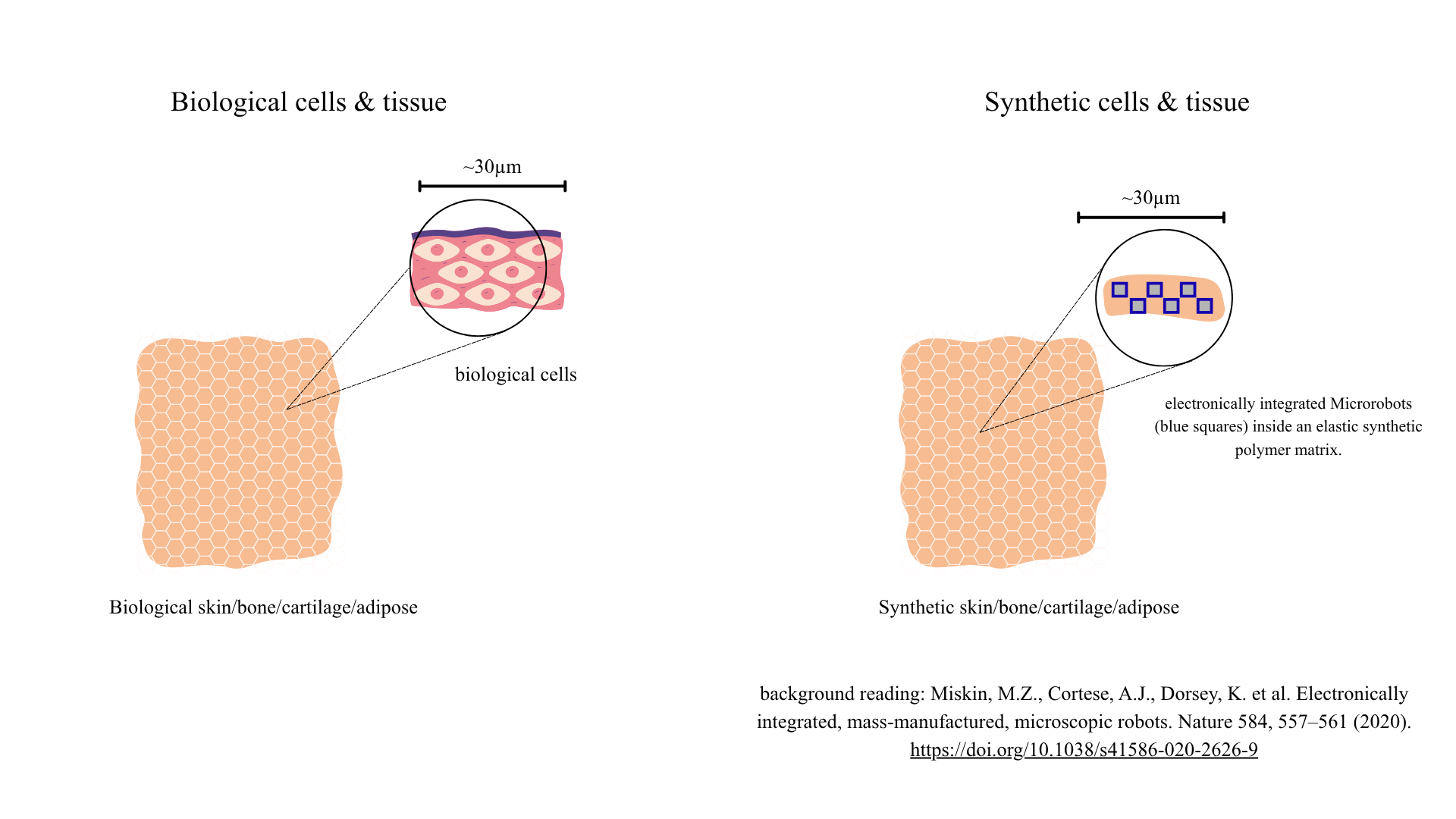
The core idea is to treat individual microrobots as functional proxies for cells, and aggregates of microrobots as functional proxies for tissues.
Microrobot aggregates would reproduce the structural and visual functions of biological tissues, including:
- adipose tissue
- muscle
- connective tissue
- cartilage and bone
- skin
- hair and fur
These aggregates could be used to construct or reshape structures such as noses, eyebrows, cheeks, breasts, buttocks, lips, arms, legs, tongues, and other anatomical features.
Additionally, to behave as integrated tissue rather than passive implants, they would also require:
- dense sensory interfacing, using large numbers of mechanosensors and neural connections to “nervify”(fill the tissue with nerves) the structure and incorporate it into the user’s body representation
- real-time immunomodulation to maintain compatibility with surrounding biological tissue
Morphological freedom?
Today, the body you inherit from your genes is basically the body you are stuck with for the rest of your life. That may not be true for much longer. We could gain the ability to edit our form much more freely, changing height, weight, sex characteristics, pigmentation, species-like traits, or even taking on forms that biology never came up with in the first place.
And maybe a single procedure to fit someone with morphocytes is not enough. Later generations could give users dynamic structural control over their biology, letting parts of the body change form repeatedly and reversibly.
A mesh of morphocytes distributed through the skin could enable dynamic appearance control, changing skin tone or patterns, creating temporary tattoos, producing iridescence, making veins more or less visible, or controlling things like blushing, goosebumps, and hair erection.
Morphocytes distributed through soft tissue and cartilage could do something similar for anatomy itself, creating temporary protrusions, ridges, folds, dimples, altered ear shapes, textured fingertips, temporary fingernail structures, or reversible changes in facial geometry.
This project is funded by Nanocytronic Inc and plans to start experimental work as soon as Mid-2027.