Nanolace
Table of contents
- Intro to Nanolace
- Definition
- “smart piercings” NOT medical devices
- Type of smart piercings
- Main Use cases
- Miscellaneous Scenarios
Intro to Nanolace
Consider a future where medical nanorobots based off designs by Miskin et al. are commonplace. They are so safe and effective that many people opt to keep them implanted at all times, using their presence to enhance the body rather than simply treat it.
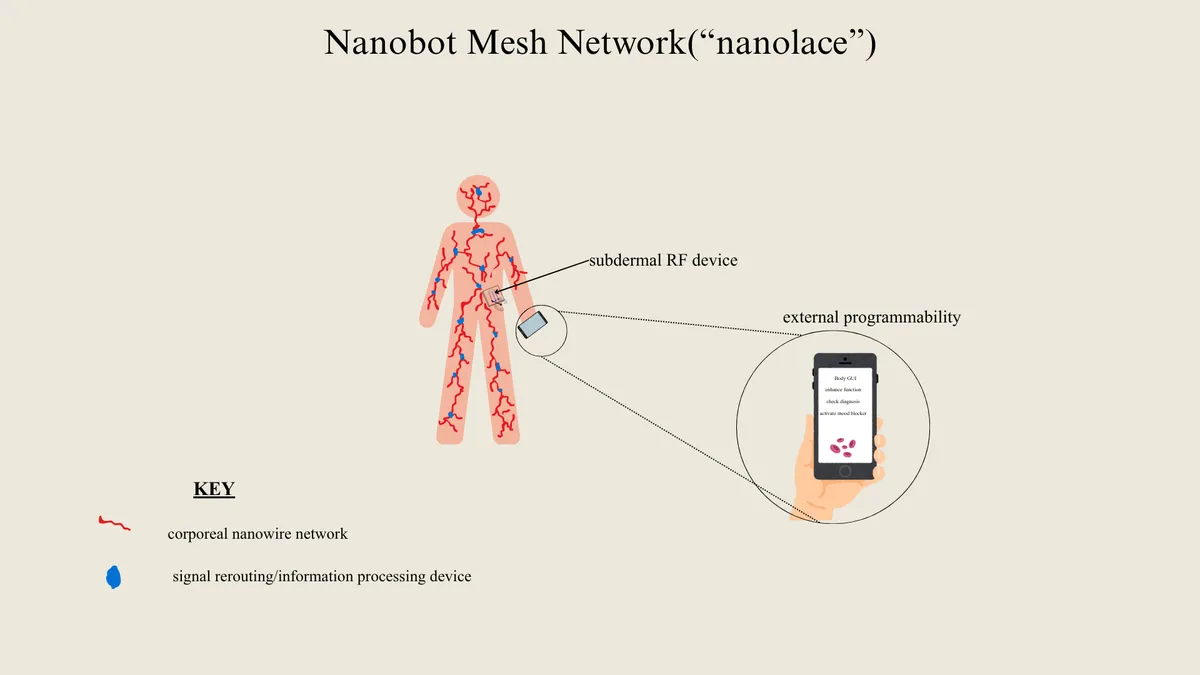
This piece is a perpetual exploration of what "nanolace" technology can do for its users. It focuses almost exclusively on the enhancement aspects of the technology, not the medical ones.
Definition: Nanolace (NAH-noh-lays)
A nanolace is a mesh of intelligent nano and micro bots, networked wirelessly or via nanowires, that sync to carry out a user's instructed commands. Use cases are diverse and include, but are not limited to: physiological enhancement, VR/AR haptics, health sensors, and novel computer interaction and control tools.
“smart piercings” NOT medical devices
A nanolace can be thought of as a “smart piercing” more than a medical device. To rigorously explore their potential, you must assume that you can walk into your local tattoo and piercings shop and get one installed that same day using cash or card, just as you would a regular piercing, such as an earring, nose ring, and whatever else people are into these days. This is intentional as to explore the entire option space that this technology gives us in regards to enhancement, one needs to discard the therapeutic modalities and examine it through the lens of a user who uses it recreationally, for vanity or in any other way other than treating poor health.
Type of smart piercings
tissue-integrated smart piercing: in skin, muscle, eye lids, ear canal, vocal chords.
deep-organ-integrated smart piercing: miscellaneous internal organs, eye cells, CNS.
Main Use cases
Depending on how much nanolace(how many nanomachines) and of what type they are, the user has a wide range of applications possibilities to use their smart piercings for. They include the following:
Novel HCI modalities
Smart piercings that let you control computer screens, browse the internet, create a spreadsheet, talk to someone, et cetera, without a computer screen or a mouse or keyboard, may very well be the next paradigm of consumer electronics that replace today's laptops, phones, VR headsets, and AirPods.
Cell/tissue Health status sensors
Behavioural stimulation:
- Physiological perfomance Enhancement
- Physchedelics
- Sexual stimulation
- skill augmentation e.g: I know kung-fu, playing piano, steady feet for dribbling, steady fingers for sewing, etc.
- Experience generation - Producing synthetic internal experiences for entertainment or art. Artificial touch, warmth, movement sensations, altered body ownership, simulated environments, moodscapes, dream-like experiences.
- somatic states: “confident posture,” “relaxed appearance,” “intimidating stance,” “performance mode,” “photogenic expression,” etc. Those would be macros controlling dozens or thousands of actuators simultaneously.
Direct inter-person communication
Body-to-body signaling that bypasses conventional screens/audio. Touch transmission, emotional-state sharing, silent signaling, shared haptics, eventually higher-bandwidth neural or physiological communication.
Morphological control
- A nanolace distributed through skin: could facilitate dynamic appearance control: changing skin tone or patterns, temporary tattoos, creating iridescence, altering vascular visibility, making veins more or less prominent, controlling blushing, goosebumps, or hair erection, or creating animated patterns that move across the skin.
- A nanolace distributed through soft tissues & cartilage: You get temporary anatomical features. Soft protrusions, ridges, texture changes, controllable folds, artificial dimples, altered ear shape, temporary fingernail structures, textured fingertips, or mechanically supported changes in facial geometry etc..
Sensory augmentation
Creating entirely new sensory channels or extending existing ones. IR/UV perception, magnetic-field sense, chemical sensing, ultrasonic perception, remote touch, machine-state awareness.
Identity / authentication
Your nanolace becoming a persistent biological cryptographic interface: proving identity, authorizing devices, unlocking spaces, signing transactions, establishing presence.
Physically secure storage for critical info
AR/VR
Miscellaneous Scenarios
Muscle response times: A mesh of well distributed nanolace in one’s thigh muscle could provide stimulus to contract their muscle cells with trivial delay once broader exertion is detected. Imagine the enhanced games of the future featuring athletes with implanted nanolaces giving them artificially-inflated response times.
What happened to your optic nerve?: A sufficiently advanced nanolace platform could enhance or entirely replace function of the optic nerve..... What might the consequences of this be? faster image-perception times?.... being able to see new colours if novel photodetectors were additionally attached to the user’s retina? Only time will tell. (notice the “user” wording. To rigorously explore enhancement, it is imperative to assume that these technologies are used recreationally, for vanity or in any other way than treating poor health)
Whispering in IR: Have you ever wanted to tell someone something in secret? perhaps when you and your romantic partner were in the same room as with your parents, or kids, or strangers, and didn't want to freak them out by flirting out loud, so you texted them instead. Well, given a future with the ubiquitous use of nanolace technology, you could use nano-meshes implanted in your vocal cords and oral cavity to inaudibly construct sentences which could then be sent to another person wirelessly (perhaps as wifi or IR), picked by nano-meshes in their auditory canal and decoded into sound that is then perturbed into their cochlea. All invisibly! I for one am looking forward to whispering to people in IR, are you?