Phase two Complete
Published 6th July 2026
Table of contents
- Core learnings that have come out of this.
- The biggest change
- The densityconomics curve
- Nanosystems generations were defined
- Many exploration pieces on nanorobot operation, apparatus, speculative structure, etc were published
- Next Steps: Phase 3
- World’s first nanorobots before 2030?
- References
Core learnings that have come out of this.
- The biggest change
- The initial plan was to use molecular cages to manufacture discrete macromolecules of cellulose and have those serve as building blocks for our nanomachines [1][2].
- Not surprisingly, it changed because going single monomer on the first try is hard. Compromise was made and a more incremental path was taken for the V1 where we instead chose to use macromolecular and particle-quantities of a structural material nanofluidically conveyed to a site and later joined together with a nanoadhesive chemical into complex shapes..
- The densityconomics curve
- The cost of nanomanufacturing was explored in a detailed essay.
- Here I derived a metric known as "the densityconomics value" that measures how economical nanomanufacturing is and asserted that one of the biggest cost drivers for our operations in the future will be how much it costs to nanomanufacture per nanopixel of an object.

- Nanosystems generations were defined
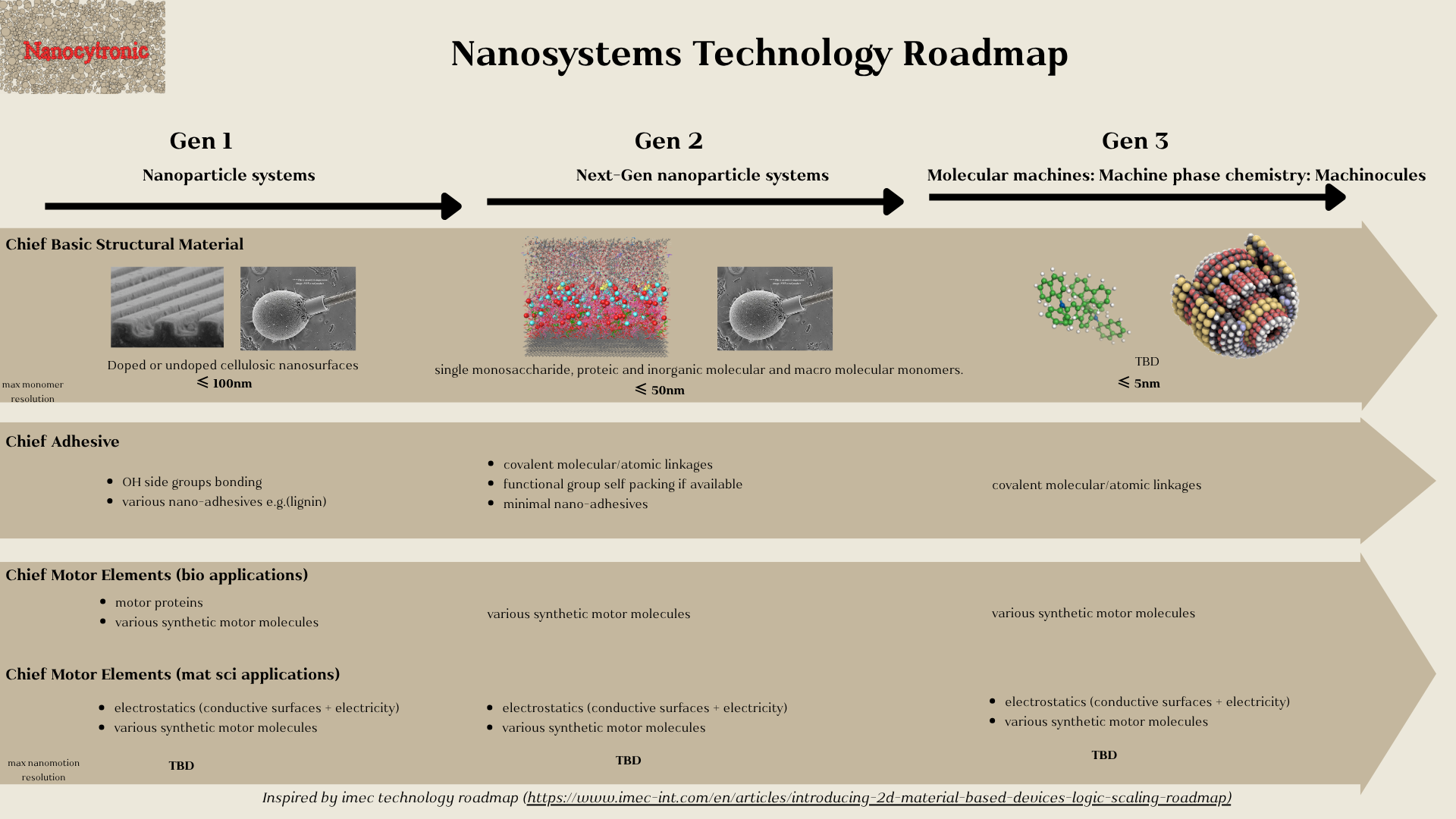
Many exploration pieces on nanorobot operation, apparatus, speculative structure, etc were published:
- Nanoagents Locomotion And Compute Apparatus Gallery: https://archive.org/details/nanoagents-locomotion-and-compute-apparatus-gallery
- Nanoprobe Mechanism Assets: https://archive.org/details/nanoprobe-mechanism-assets
- Design Of An Experimentally Accessible Autonomous Medical Nanoagent :Computation, Sensing, Perturbations, And Locomotion Via Motor Protein Signal Transmission: https://archive.org/details/design-of-an-experimentally-accessible-autonomous-medical-nanoagent-computation-
Next Steps: Phase 3
- Fundraising: As we speak, we are in the middle of a fundraise. A promising lead is on the horizon. More on this in the future!
- Nanomanufacturing proving: Post raise, the goal is now to build a nanocomposite factory like the one mentioned here
- Nanomotor proving: Alongside the nanocomposite factory, high fidelity simulations of the nanomotors is another element to derisk for this next phase.
World’s first nanorobots before 2030?
- A raise will be in order after we finish phase 3. And from there, the world’s first truly programmable/computer controllable nanoprobes.
- Hopefully we can beat Ray Kurzweil’s 2030 prediction for nanorobots
References:
- Cage nanoreactors article: https://open.substack.com/pub/colinyaps/p/using-a-cascade-of-molecular-reactor?r=1yq3uz&utm_campaign=post&utm_medium=web&showWelcomeOnShare=true
- Literature validation of cage nanoreactors: https://archive.org/details/literature-validation-of-a-cascading-molecular-reactor-cage-architecture-for-a-m