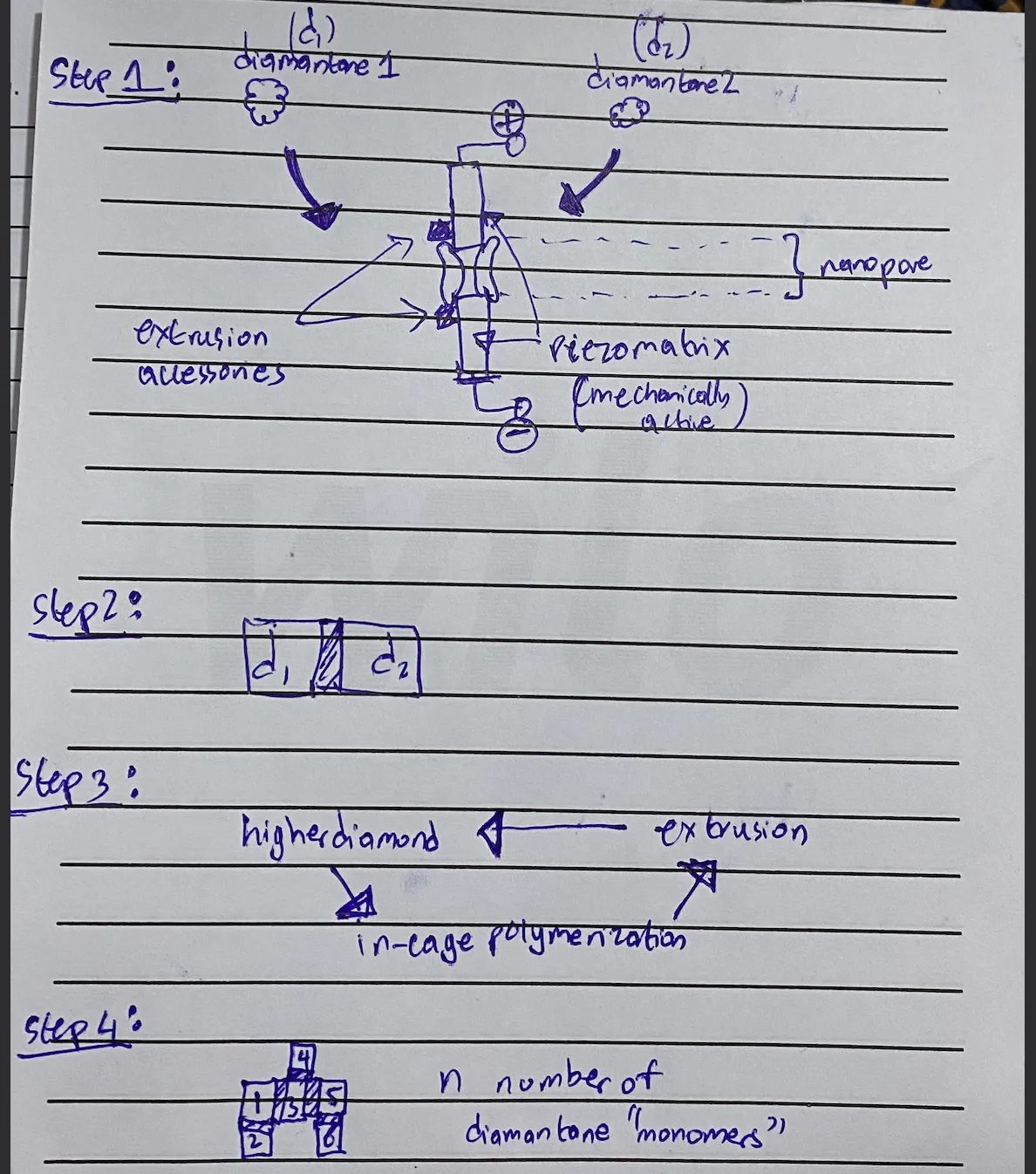
Twin Cage Mechanosynthesis of Higher Diamondoids
Step one: Hydrogen group replacement
In this method, the hydrogen groups of a diamondoid (e.g. diamantane) are replaced with alternative reactive functional groups e.g. halogens or amines.
Step two: Prepare two fused molecular cages
Prepare two fused molecular cages with geometries specifically tuned for diamantane. These would be placed in a piezoelectric matrix and inlets would be created for feedstock diamantanes to get in.
Step three: Building diamond
By mechanically actuating the cage or having the cages react with the diamantanes, the two precursor molecules can be made reactive such that when placed together in the diamond lattice template position, the carbons link up to form a perfect C crystal.
This can be continued and larger cages can be synthesized to:
- polymerise even larger molecules 0r
- polymerise at different sites of the growing diamondoid nanoparticle to get various geometries.
Below is a schematic I created in 5 minutes to visually explain this: