Nanomechanical Desalination Membrane Farms
Some facts about water Scarcity
Fact one: The world currently consumes 4.3 trillion cubic meters of freshwater per year, and that number is projected to climb another 20-30% as population and industry grow. [1] [3]
Fact two: We need freshwater production capacity to reach roughly 5.2 trillion cubic meters by 2050.
Fact three: Beyond basic quality of life, scarcity is a social accelerant for conflict. Zero-sum resource competition tends to push societies toward war, not cooperation.
Fact four: We have to solve this and desalination is the most physically obvious path forward. All the billions of cubic kilometers of the ocean are right there.
The most used Desalination methods today
The two dominant desalination methods today are thermal distillation and reverse osmosis (RO)[5]
Thermal distillation works by heating saltwater until it evaporates, then condensing that vapour into fresh water. The salt gets left behind. It's simple and reliable, but it's energy hungry, which makes it expensive to run at scale.
Reverse osmosis uses pumps to push saltwater through a semi-permeable membrane. The membrane blocks the salt and lets the water through. No heating required, most energy is the mechanical force needed to pump water, which is why membrane RO has become the more cost-effective option, especially at smaller scales[4]
Membrane RO has a core maintenance problem: things get clogged.
The membrane is doing a lot of work, and the ocean is not a clean environment. Several categories of contaminants degrade efficiency over time and eventually force cleaning or full replacement. They include:
- Ionic contamination which is the most straightforward culprit. Calcium, magnesium, and other dissolved salts precipitate out and form crystals on the membrane surface.
- Dissolved organic carbon (the microscopic carbon-based compounds small enough to slip through conventional filtration) adds another layer of fouling.
- Then there are the biologicals: bacteria, viruses, colloids, and other insoluble particulates that accumulate and restrict flow.
The most aggressive of these is biofouling. In the presence of water are microorganisms, algae, and small organisms which colonize surfaces and steadily choke membrane performance. The result is a system that requires constant chemical cleaning, careful pre-treatment, and periodic membrane replacement. All of that costs money and downtime.
What if we removed all of those constraints entirely?
I posit that the ultimate desalination tools are membranes lined with nanomechanical elements. These nanoscale tools would be built on the manufacturing and nanomotor capabilities described in previous work[6][7][8]
Imagine farms of these large sheets deployed across shallow coastal waters. When done, desalinated water rises or is actively pumped to the surface. Brine, being denser, sinks naturally or is trafficked to storage tanks by nanomechanical agents. And power comes from floating or shore-mounted solar panels paired with battery storage.
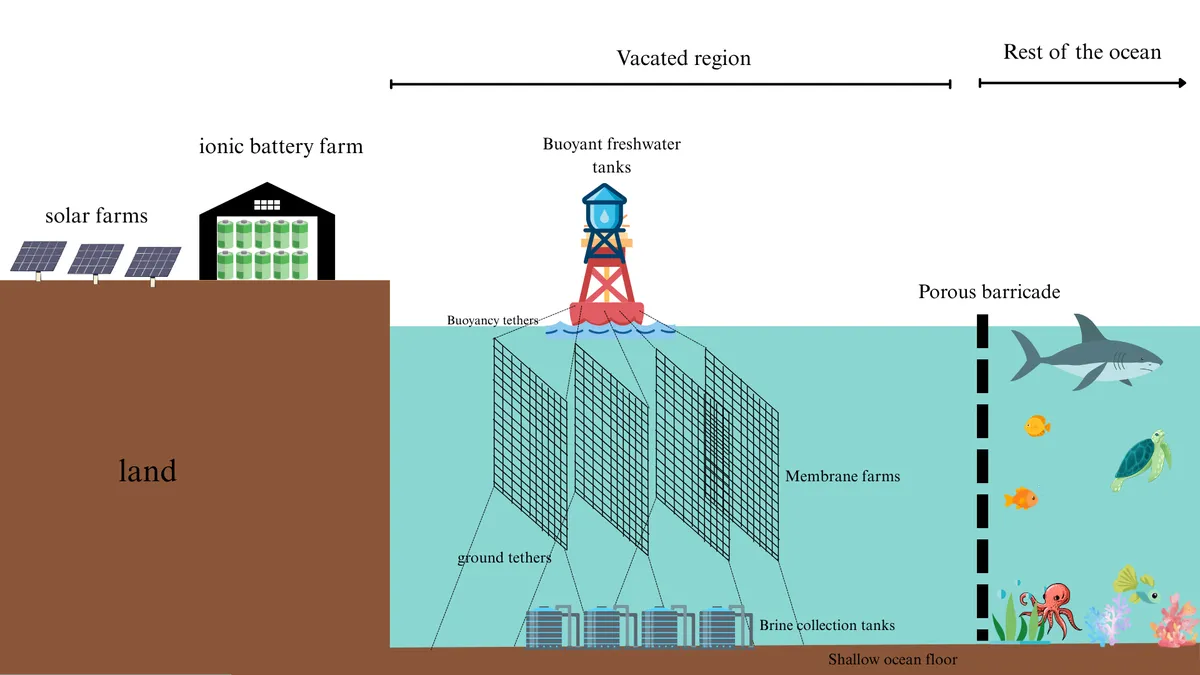
Here is what each piece actually solves:
- Self-cleaning and self-repairing membranes. Nanoprobes embedded in the membrane surface mechanically clear biofouling, ionic deposits, and insoluble particulates in real time. No chemical cleaning cycles, no scheduled downtime. Because the probes are also sensors, you get continuous nanoscale readouts of membrane integrity and filtration performance across the entire system.
- Brine as a resource, not a waste product. Brine is dense in ions. Ions are the core feedstock for ionic batteries. Rather than disposing of concentrate, you extract those ions and build battery capacity on-site, storing solar energy for pumping and pressure work. The waste stream becomes infrastructure.
- Recursive economies of scale. Every kilogram of brine processed adds to your battery stockpile, which increases operational capacity, which lets you process more. The system compounds on itself. More throughput funds more throughput.
- Volumetric pumping efficiency. Instead of piping ocean water into a land-based facility, you bring the membranes to the water. Shallow coastal areas, currently underutilized, become saturated with membrane nets spanning up to a cubic kilometer of volume. And if a nanopump is available every few nanometers or micrometers across that surface, you are extracting water at a density no conventional pump array can match.
References
- Water Consumption Statistics https://irrigreen.com/pages/water-consumption-statistics?srsltid=AfmBOopp16zEWEXio-ljqTOD1XeRXfDxpxK57ibSH14OFtzwvS2Z61fN
- UN Water (Water Facts) https://www.unwater.org/sites/default/files/2025-01/UN-Water_Water_Facts_one_pager_January_2025.pdf
- Water Use and Stress https://ourworldindata.org/water-use-stress
- https://en.wikipedia.org/wiki/Desalination#Membrane_distillation:~:text=%5Bedit%5D-,Reverse%20osmosis,-%5Bedit%5D
- Great explainer of the two methods by Asianometry https://youtu.be/Dd9q30yjEqc?si=C69yz7SpsW_91-bU
- Schematic of **cellulose nano 3d printerhttps://colinkakama.bearblog.dev/schematic-of-cellulose-nano-3d-printer/
- Using a Cascade of Molecular Reactor Cages as a Nanomanufacturing Platformhttps://open.substack.com/pub/colinyaps/p/using-a-cascade-of-molecular-reactor?r=1yq3uz&utm_campaign=post&utm_medium=web&showWelcomeOnShare=true
- Collection of literature on motor protein locomotion phenomena (basis for nanomotors and devices)https://colinkakama.bearblog.dev/collection-of-literature-on-motor-protein-locomotion-phenomena-basis-for-our-nanomotors-and-devices/